Aswan region · colour and ownership
The painted Nubian facade
A colourful house front is easy to treat as a ready-made image. A better reading starts with structure: wall, opening, border and threshold—then asks how paint gives those parts emphasis.
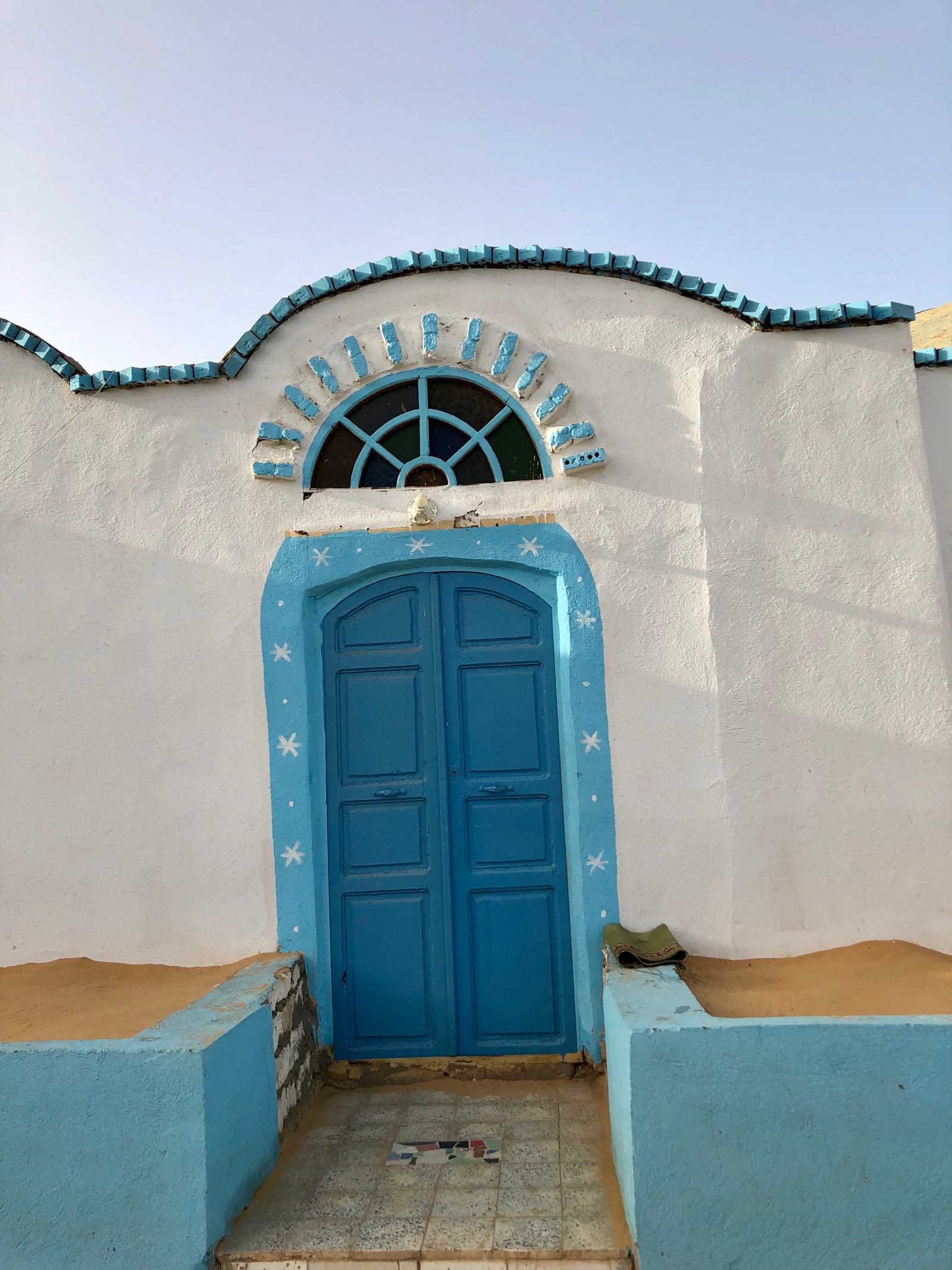
Draw the wall before the decoration
Nubian architecture encompasses different communities, histories and settlements; no single photographed facade represents the whole tradition. Begin with the particular house in front of you. Outline the main wall plane, roofline, doorway, windows and any projecting or recessed parts. Only then add painted zones.
This order reveals what colour is doing. A border may enlarge the visual presence of a small opening. A contrasting band may separate the lower wall from the upper field. Repeated triangles, diamonds, lines or figurative motifs may establish rhythm across an otherwise simple surface. Paint works with architecture rather than replacing it.
The doorway concentrates attention
Entrances often receive greater visual emphasis than blank wall. This makes spatial sense: the threshold is where approach becomes entry, where exterior identity meets interior privacy. Look at the layers around a door. There may be a structural opening, a plaster edge, a painted frame and smaller marks that guide the eye inward.
Do not turn that invitation into assumed access. A strongly marked entrance remains the entrance to somebody's home unless clearly presented otherwise. Observe from a legitimate public position, avoid blocking movement and never open or lean against a door for a photograph.
Visual welcome and physical permission are not the same thing.
Colour creates hierarchy
List the colours by area rather than by preference. Which colour covers the largest field? Which is reserved for outlines? Which appears only as a small accent? A bright hue may feel dominant while occupying very little surface because it sits against a quieter ground.
Sunlight changes that hierarchy. Strong light can flatten subtle plaster tone and intensify contrast; shade can make neighbouring colours feel closer. Dust, repainting and surface wear create another layer. The facade seen today is not necessarily an untouched original state, nor should maintenance be dismissed as loss of authenticity. Repainting can be part of continued use.
Motifs need context
A shape should not be assigned a fixed symbolic meaning on visual resemblance alone. Similar geometry can carry different histories or simply support composition. Reliable interpretation belongs to documented local knowledge and, where appropriate, the people connected with the house.
For an independent visitor, the honest method is descriptive before symbolic: name position, repetition, scale and relation to the opening. “A row of blue triangles follows the roofline” is evidence. A universal claim about what every triangle “means” may not be.
Texture keeps colour architectural
Paint sits on a physical surface. Look for the unevenness of plaster, repair edges, brush direction and places where wall material affects colour. A facade is exposed to sun, dust, touch and weather. Its texture prevents the design from becoming a flat graphic file.
Finish by looking at the roofline. Painted borders may meet parapets, rounded forms or a hard horizontal edge, and the final band determines how the house sits against the sky. A repeated motif near the top can make the wall feel taller; a broad quiet field can hold attention closer to the doorway. This upper edge completes the composition even when the photograph is cropped below it.
A respectful facade record
- Sketch the main wall and openings without colour.
- Add the three largest painted zones in order of area.
- Mark one repair, wear line or change in surface texture.
- Record only the motifs you can describe without inventing meaning.
- Keep residents out of photographs unless they clearly consent.
A house is not a style board
Nubian colour is frequently borrowed in hospitality and tourism imagery. Admiration can become extraction when a lived facade is stripped of place, ownership and difference. Resist turning one house into a universal “Nubian palette” or copying its motifs without understanding their context.
The more careful outcome is architectural literacy: noticing how colour strengthens an opening, organizes a wall and records maintenance. If local access or explanation is offered legitimately, listen without treating hospitality as a right. The facade remains part of a community before it becomes a visitor's image.

.jpg)