Historic Cairo · screen and privacy
Mashrabiya: the filtered boundary
A mashrabiya does not behave like a clear pane or a solid wall. Its turned-wood lattice produces degrees of visibility, patterned shade and a projecting volume between room and street.
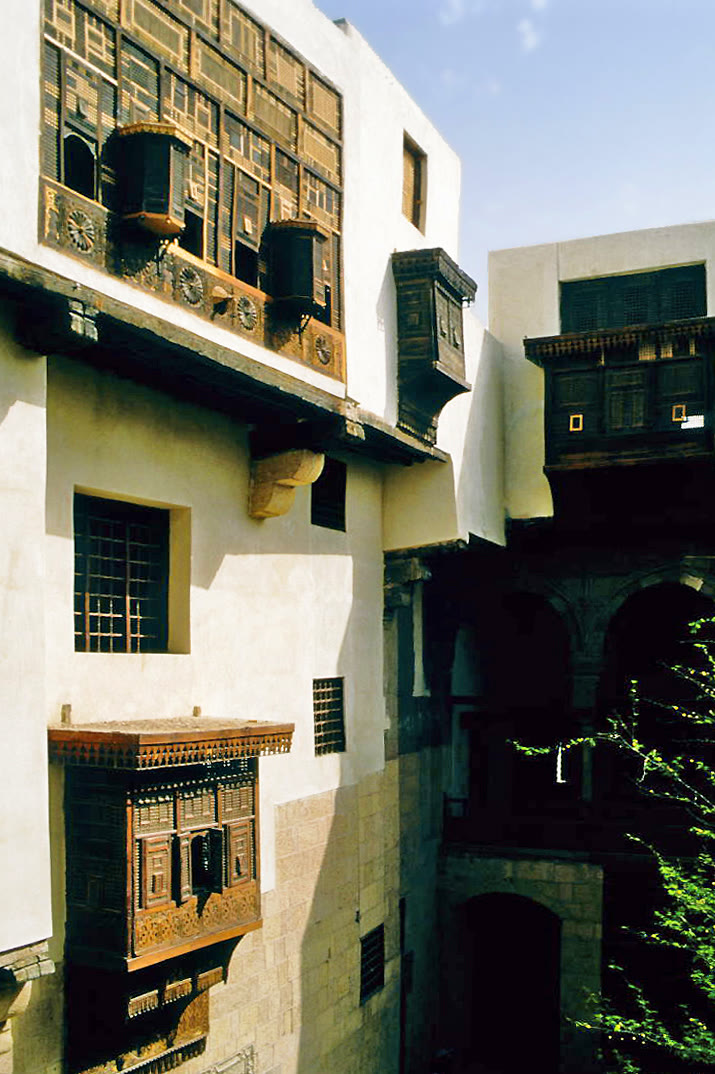
Begin with the whole projection
At Bayt al-Suhaymi, a historic house on al-Muizz Street, wooden screens are among the most immediately recognizable features. Before moving toward the joinery, step back and read the box. How far does it project? Which part of the wall supports it? Does it sit above a passage, align with another opening or turn a corner?
Projection matters because the screen is not applied decoration. It creates usable depth at the edge of an interior. The floor may extend toward the street, the side panels collect oblique light and the overhang produces shade below. A two-dimensional photograph can hide this spatial work.
Density is a design decision
Turned pieces of wood combine into lattice with openings of different scale. Some areas appear dense; others allow a clearer outward view. Read those differences rather than treating the surface as one continuous pattern. A denser zone may screen direct sight or strong light, while a more open zone changes visual connection and air movement.
Function should not be reduced to a single universal claim. Mashrabiya varied across periods, regions, rooms and individual constructions. Privacy, ventilation, shade, view, display and craftsmanship can overlap, but their relative importance must be understood from the actual building and evidence—not a slogan that every screen “naturally cools” every room.
The screen matters because it negotiates. It does not choose simply between open and closed.
Light makes the lattice readable
From the exterior, strong daylight can make the wood appear as a dark patterned mass. Inside, the relationship reverses: openings become bright and the turned elements become silhouettes. Light across the day changes the balance again. A side-lit screen reveals the rounded profiles of its pieces; flat light reduces them to graphic pattern.
Look at the shadow near the screen. The lattice may cast a pattern on an interior surface, but its sharpness depends on sun angle, distance and intervening material. A dramatic geometric shadow is a condition, not a permanent decorative panel.
View depends on position
A lattice does not provide one fixed level of visibility. Stand close and individual openings may offer narrow lines of sight. Move back and the turned pieces overlap more densely. Light levels on each side also change what can be seen. A brighter exterior and darker interior create a different visual relationship from evening conditions.
This positional effect is essential to privacy. It also makes direct visual testing inappropriate in a lived or sensitive setting. Do not press cameras against screens, peer into private interiors or assume an opening exists for a visitor's access. Study the publicly presented architectural surface from the permitted route.
Craft is repetition with tolerance
The lattice is assembled from many small wooden units. Repetition creates order, but age, repair, handwork and material movement introduce variation. Trace one horizontal or vertical band and notice where spacing, colour or profile shifts. A repaired section may be evidence of conservation rather than a flaw.
Do not overlook the solid framing around the lattice. Posts, rails, brackets and side panels carry and contain the delicate field of turned pieces. Their larger scale gives the eye a hierarchy: first the projecting box, then its structural frame, then the fine screen. Without that hierarchy, pattern would lose its architectural position.
A five-part screen reading
- Outline the full projecting volume.
- Separate dense and open lattice zones.
- Identify the direction of strongest light.
- Compare view from close and farther positions without intruding.
- Look for repair, weathering and changes in wood tone.
Return the object to the house
Mashrabiya is often isolated as a visual emblem of “Islamic Cairo.” At Bayt al-Suhaymi it belongs to a larger domestic ensemble of rooms, courtyards, circulation and layered occupation. The screen only makes full sense when connected to what lies behind, beside and below it.
Current opening arrangements, conservation zones and photography rules may change. Follow on-site guidance and preserve circulation for other visitors. A careful reading does not require touching the wood or manufacturing a private viewpoint. The screen's intelligence is already visible in its depth, density and control of the boundary.

